


An Inside Look at Hannah's Situation and The Lord of Hosts
Updated: Aug 18
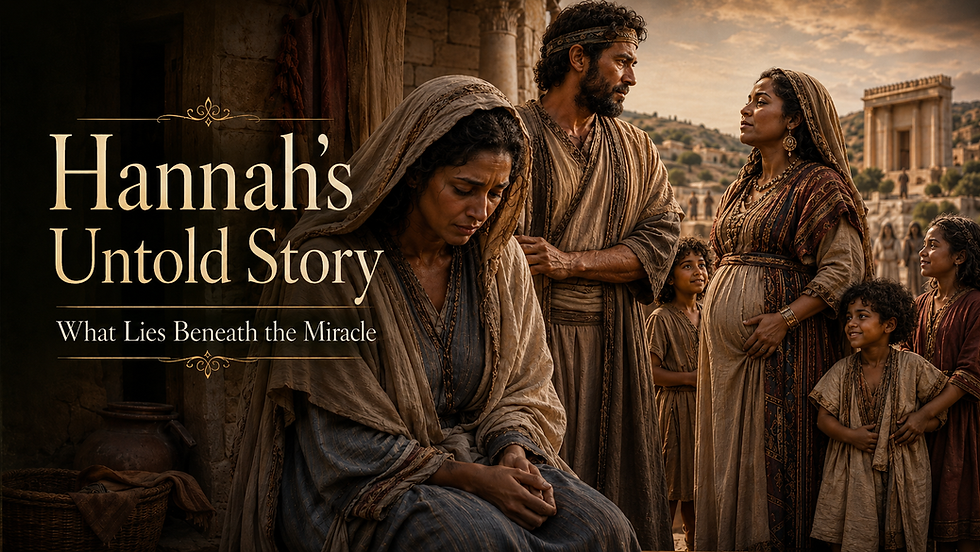
An Overview of "Hannah’s Prayer"
When the story of Hannah is preached, most messages begin with her prayer and end with the birth of Samuel.
We hear about the woman who went to the house of the Lord with a broken heart. We hear how she prayed so intensely that Eli mistakenly believed she was drunk. We hear about the vow she made before God and how the Lord remembered her. Then, at last, Samuel—the child for whom she prayed—was born.
It is a beautiful testimony of prayer, faith, surrender, and answered petition.
But Hannah’s story did not begin at the altar.
Before there was a miracle, there was a troubled household. Before Hannah poured out her soul before the Lord, she had endured years of disappointment, humiliation, rivalry, emotional torment, and helplessness.
Her pain was not caused by barrenness alone.
Hannah Was Living in a Divided Household
First Samuel introduces Elkanah as a man with two wives:
“And he had two wives; the name of the one was Hannah, and the name of the other Peninnah: and Peninnah had children, but Hannah had no children.”—1 Samuel 1:2
The Bible does not tell us which woman Elkanah married first. It also does not tell us why he entered a polygamous marriage. Therefore, we should be careful not to declare as fact that Peninnah was married only because Hannah could not have children.
What the text does tell us is that Elkanah’s household was divided.
Peninnah had children.
Hannah had Elkanah’s affection.
Each woman possessed something the other may have desired, and instead of peace, the household became a place of rivalry.
Polygamy may have been practiced in biblical times, but the Bible repeatedly shows us the disorder it produced. Abraham, Sarah, and Hagar experienced conflict. Jacob’s marriages to Leah and Rachel created jealousy, competition, and pain. Elkanah’s household was no different.
The presence of two wives created the conditions for comparison, favoritism, resentment, and emotional warfare.
Peninnah Turned Hannah’s Wound Into a Weapon
Scripture calls Peninnah Hannah’s “adversary” or rival.
“And her adversary also provoked her sore, for to make her fret, because the Lord had shut up her womb.”—1 Samuel 1:6
Peninnah did not merely enjoy the blessing of her own children. She used Hannah’s lack of children to torment her.
This was not an accidental comment made during a moment of frustration. The Bible says Peninnah provoked Hannah “year by year” when the family went to worship at the house of the Lord.
The torment was repetitive.
It was intentional.
It was aimed directly at Hannah’s most painful wound.
Peninnah knew what hurt Hannah, and she returned to that place again and again.
Perhaps Peninnah was jealous because Elkanah loved Hannah. Perhaps she resented the special portion he gave Hannah. Perhaps she felt that despite bearing Elkanah’s children, she remained second in his affection.
The Bible does not explicitly explain Peninnah’s motives. However, jealousy may explain cruelty; it does not excuse it.
Peninnah was also living in a complicated and unequal relationship, but she chose to release her pain by inflicting pain upon another woman. Instead of confronting the dysfunction within the marriage, she attacked Hannah.
Wounded people can wound other people—but being wounded does not give anyone permission to become an abuser.
Elkanah Contributed to the Rivalry
Elkanah is often presented as a loving husband because he gave Hannah a special portion of the sacrifice.
“But unto Hannah he gave a worthy portion; for he loved Hannah: but the Lord had shut up her womb.”—1 Samuel 1:5
His love for Hannah may have been sincere, but his actions also publicly displayed his preference.
Every year, Peninnah and her children received their portions, but Hannah received a special portion because Elkanah loved her. When infact the larger portion belonged to Peninnah since she had his children.
What he intended as comfort may have intensified the rivalry.
Elkanah did not create Peninnah’s cruelty, and Peninnah was responsible for her own behavior. Nevertheless, Elkanah helped maintain a household in which favoritism was visible, resentment was growing, and one wife was repeatedly tormenting the other.
Even more troubling is that the text gives no indication that Elkanah confronted Peninnah or protected Hannah from her abuse.
He saw Hannah crying.
He knew she was not eating.
He knew her heart was grieved.
Yet instead of addressing the source of the torment, he asked:
“Hannah, why weepest thou? and why eatest thou not? and why is thy heart grieved? Am not I better to thee than ten sons?”—1 Samuel 1:8
Elkanah may have believed he was comforting her, but his words centered his own value instead of acknowledging Hannah’s pain.
“Am I not better to you than ten sons?”
In other words, “Shouldn’t my love be enough?”
But Elkanah’s affection could not replace the child Hannah desired. His special treatment could not remove Peninnah’s harassment. His question did not address the hostile environment inside their home.
Sometimes people believe they are helping because they provide gifts, money, affection, or encouraging words. But if they refuse to confront the person causing harm, their gestures may provide temporary comfort without producing real protection.
Out of his authority, Elkanah gave Hannah a larger portion, but he did not appear to use his authority to stop the torment. He was passive and focused on resolutions that on intensified the situation.
Hannah Was Trapped in a Situation She Could Not Fix
Hannah had very little power within this family structure.
She could not force Peninnah to stop provoking her.
She could not make Elkanah confront the dysfunction and put an end to it.
She could not open her own womb.
She could not remove herself from the marriage with the freedom and resources available to many people today.
She was surrounded by circumstances she could neither control nor correct.
That is the deeper backstory behind Hannah’s prayer.
She was not simply a woman asking God for a baby. She was a woman crying out from within a painful system.
Her prayer came from years of being reminded of what she did not have. It came from the humiliation of watching another woman use motherhood as a weapon against her. It came from being deeply loved by a husband who still did not fully understand or protect her. Hannah was left to fight alone, even in prayer Hannah prayed alone. Elkanah did not join Hannah in prayer to petition God for a reslove in her barreness.
Hannah’s tears were carrying more than one burden.
Hannah Appealed to the Lord of Hosts
In her powerlessness, Hannah turned to the One who possessed all power.
“And she vowed a vow, and said, O Lord of hosts, if thou wilt indeed look on the affliction of thine handmaid, and remember me, and not forget thine handmaid…”—1 Samuel 1:11
Hannah called upon the Lord of Hosts—the God who commands the armies of heaven.
She did not appeal merely to a God who could provide fertility. She appealed to the God who could see her affliction, remember her in her helplessness, and intervene in circumstances beyond her control.
Hannah repeatedly called herself the Lord’s handmaid. She placed her wounded life into God’s hands because human hands had failed her.
Peninnah would not show mercy.
Elkanah appeared passive and did not fully understand.
Eli initially misjudged her.
But God saw her correctly.
When Eli accused Hannah of being drunk, she answered:
“No, my lord, I am a woman of a sorrowful spirit… I have poured out my soul before the Lord.”—1 Samuel 1:15
That is what Hannah’s prayer truly was: the pouring out of a soul that had held too much for too long. Hannah went to war, she called on the Lord of Hosts.
God Did Not Ignore Hannah’s Affliction
Scripture says, “The Lord remembered her.”
God’s remembrance does not mean He had forgotten Hannah and suddenly recalled her name. In Scripture, when God “remembers,” it often signals that He is preparing to act according to His covenant, mercy, and purpose.
Hannah conceived and gave birth to Samuel.
The child was not only an answer to her prayer. Samuel became a prophet, priestly servant, and leader during a critical transition in Israel’s history. He would anoint both Saul and David.
Peninnah had mocked Hannah as though her present condition determined her permanent future.
But Peninnah could not see what God was preparing.
The woman she called barren would give birth to a child whose name would be remembered throughout generations.
This is why David’s words in Psalm 23 are so powerful:
“Thou preparest a table before me in the presence of mine enemies.”—Psalm 23:5
God did not need Peninnah to leave the room before blessing Hannah.
He did not need her approval.
He did not need her cooperation.
He prepared Hannah’s answer in the presence of the person who had used Hannah’s pain against her.
Did Samuel’s Birth Resolve Everything?
The birth of Samuel silenced one accusation, but the Bible does not tell us that every conflict in Elkanah’s household disappeared.
A baby could not automatically correct years of rivalry.
A child could not make Peninnah repent.
Samuel’s birth did not necessarily cause Elkanah to recognize his contribution to the household’s dysfunction.
God answered Hannah’s prayer, but the text does not say that every damaged relationship was instantly healed.
This distinction matters.
Sometimes God changes our circumstances. Sometimes He changes our position within those circumstances. Sometimes He gives us strength, purpose, or a future that our enemies could not prevent.
But an answered prayer does not always mean every person involved has changed.
God’s intervention does not excuse those who caused the pain.
Peninnah remained responsible for her cruelty.
Elkanah remained responsible for the environment he helped create and for what he failed to confront.
Hannah’s vindication did not make their behavior acceptable. It demonstrated that their behavior did not have the final word.
God’s Justice Is Seen Throughout Scripture
Hannah’s story is not the only biblical account in which God saw someone who had been rejected, mistreated, or placed in an unfair situation.
Leah was given to Jacob through her father’s deception. She lived with the pain of knowing that her husband loved Rachel more. Yet God saw that Leah was unloved and opened her womb. Through Leah came Judah, and through the tribe of Judah came the earthly lineage of Jesus Christ.
Hagar the Egyptian Slave, was caught in the back draft of Sarah's sin and made to bore the punishment alone. Sarah had given her to Abraham not with consent, but under the obligation of slavery, God had already made the promise to Abraham and Sarah. Yet Sarah and Abraham played god anyway. After giving birth to Abrahams son Hagar was then turned out. Sarah Abraham's wife was tormented with jealously caused by her own sin to produce an heir. But the Lord of Hosts redeemed Hagar through she and Abraham's son Ishmael.
David was hunted by Saul, although David had served him faithfully. Saul manipulated David, used his daughters as part of his schemes, and repeatedly sought his life. Yet Saul could not destroy the future God had ordained for David.
Joseph was betrayed by his brothers, sold into slavery, falsely accused, and forgotten in prison. Yet God raised him to a position of authority and used him to preserve the very family that had rejected him.
In each story, God’s intervention looked different.
God did not always remove the pain immediately. He did not prevent every act of injustice. But He demonstrated that human cruelty, favoritism, rejection, and manipulation could not cancel His purpose.
God is not blind to what happens behind closed doors.
He sees the family dynamics other people overlook.
He sees the spouse who remains silent while another person is being mistreated.
He sees the person who uses someone else’s vulnerability as a weapon.
He sees the tears that are hidden during the day and released only in prayer.
And He sees the Hannahs who have been told, directly or indirectly, that their present affliction defines their worth.
The God Who Saw Hannah Still Sees
Hannah’s testimony is larger than the birth of Samuel.
It is the testimony of a God who sees a woman trapped inside a painful situation.
It is the testimony of a God who listens when other people misunderstand.
It is the testimony of a God who can answer a prayer while also exposing the dysfunction surrounding it.
It is the testimony of a God who can bring purpose out of a place of humiliation.
Hannah entered the house of the Lord unable to eat, weeping bitterly, and carrying years of sorrow. She left before her circumstances had changed, but Scripture says her countenance was no longer sad.
Something happened before Samuel was conceived.
Hannah entrusted her case to God.
She placed her torment, her marriage, her barrenness, her rival, her husband’s limitations, and her uncertain future into the hands of the Lord of Hosts.
God later gave Hannah three more sons and two daughters. The woman who had once been tormented because she had no children became the mother of six.
Yet her greatest victory was not simply that she finally had children.
Her greatest victory was that what Peninnah used to shame her became the place where God displayed His faithfulness.
Hannah’s enemies saw barrenness.
God saw a mother.
Her household saw weakness.
God saw a woman of prayer.
Others saw an unanswered petition.
God saw Samuel.
The story of Hannah reminds us that God does more than hear our words. He understands the entire backstory behind our prayers.
He knows who contributed to the pain.
He knows who remained silent.
He knows what has been taken, delayed, denied, or used against us.
And when the Lord of Hosts steps into a situation, He is able to do more than provide temporary relief. He can restore dignity, real purpose, overturn shame, and establish a future that no adversary can prevent.
The enemy may be present when God prepares the table.
But the enemy does not decide what God places upon it.
Comments